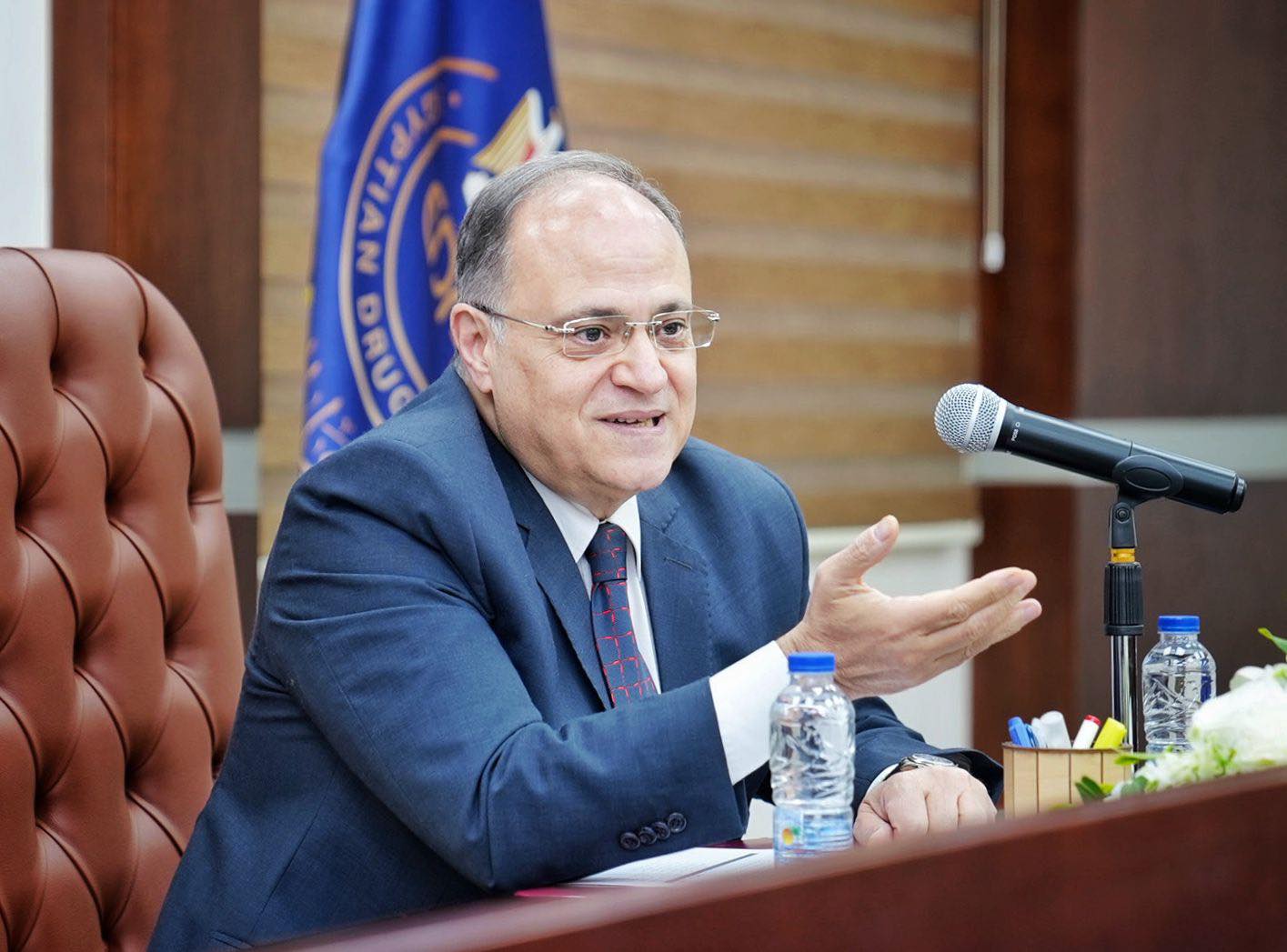

Dr. Khaled Meselhy Ibrahim - Professor of Pharmacognosy, Director of the Career Guidance and Entrepreneurship Center, and Consultant to the Artificial Intelligence Unit at the Faculty of Pharmacy, Cairo University
At first glance, one might assume the title contains a typographical error and that "challengesتحديات " rather than "encroachmentsتعديات " was intended. However, the term "encroachments" is indeed deliberate, as the pharmaceutical labor market has become saturated with violations that have exceeded the bounds of mere challenges. Encroachments upon one of the most sensitive and professional occupations have become a daily, indeed hourly, occurrence. Although most professional violations originate from outside the profession, regrettably, some encroachments emanate from within the pharmacy community itself. The following examples illustrate these transgressions against the profession, encompassing both internal and external violations:
The proliferation of pharmacy faculties within universities and the unplanned increase in graduate numbers, far exceeding the actual requirements of the pharmaceutical labor market, poses a significant threat and severe encroachment upon the pharmacy profession and graduate quality. Graduates find themselves disoriented in a labor market oversaturated with both pharmacists and non-pharmacists practicing pharmacy.
A pharmacist's compromise in attempting to dispense an illegible prescription based on approximation constitutes an explicit violation of professional standards, jeopardizing patient safety and the pharmacist's career. Pharmacy curricula do not include courses in handwriting decipherment, nor should our role be reduced to decoding illegible prescriptions—this is not professional competence but rather a debasement of a profession where errors can cost lives. Any illegible prescription must be refused to safeguard patient health and uphold professional integrity.
The marginalization of clinical pharmacists' roles in their workplaces and the limitation of their specializations in hospitals and healthcare facilities, contrary to scientific and legal mandates, constitutes an encroachment upon the pharmacy profession and compromises patient care.
The infiltration of non-pharmacists into pharmaceutical practice within pharmacies and companies has become a widespread phenomenon aimed at reducing salaries. This represents an explicit violation of the pharmacy profession and undermines pharmacists who endured the most challenging years of their lives in the most demanding academic programs, only to find non-pharmacy professionals competing vigorously with them in the labor market.
The provision of specialized, explicit programs specific to pharmaceutical practice, offered for fees within non-pharmacy faculties or through unrecognized centers, threatens the professional integrity of pharmacy and represents deliberate attempts to legitimize pharmaceutical practice by non-pharmacists. I never envisioned encountering the term "pharmaceutical" within non-pharmacy faculties, yet it now appears in programs offered by institutions entirely unrelated to health and pharmaceuticals.
As pharmaceutical sciences advance rapidly daily, with artificial intelligence becoming increasingly integrated into pharmacy, and emerging fields such as health economics and soft skills gaining prominence, pharmacists who fail to develop their capabilities and skills, advance their education, and remain anchored to decades-old knowledge commit an explicit violation against the profession. This represents a loss of professionals who once championed the profession but now reject continuous pharmaceutical development and education.
While the global community advocates for expanding pharmacists' roles in healthcare—including vaccination authorization, specialized pharmaceutical nutrition therapy, and intensive care pharmacy—all requiring legislation, study, and training, our lack of awareness regarding these initiatives and contentment with traditional roles that confine us represents a deliberate self-imposed limitation and restriction upon the profession.
When pharmacists attempt to exceed their professional boundaries and encroach upon other professions—such as pharmacist pages proliferating on social media that display images of medical conditions requesting rapid diagnosis from pharmacists without directing patients to physicians—this constitutes transgression. Diagnosis is not our profession, and erroneous diagnosis endangers patient lives. Assuming the physician's role represents an explicit encroachment upon pharmacy, as our professional scope is clearly and explicitly defined, and any deviation constitutes professional violation.
The promotion and sale of medications on social media platforms or within clinics represents an explicit encroachment upon the pharmacy profession. Licensed, effective, safe, and regulated medications belong exclusively in pharmacies. Any medication dispensed outside pharmaceutical premises constitutes a blatant professional violation and threatens patient safety by exposing them to medications of unknown origin, unregulated, and completely unsafe.
The preceding examples represent illustrative rather than exhaustive instances of encroachments upon the pharmacy profession.
We must all take pride in our profession and remember that during the global pandemic, the entire world, with all its resources and might, awaited any advancement from pharmacists—whether in developing therapeutics or vaccines to save humanity, or in providing healthcare support during the evident crisis. Indeed, pharmacy and pharmacists worldwide exemplified professional excellence, contributing heroically alongside healthcare teams globally. The world has since recognized pharmacy's crucial importance, both in healthcare provision and in ensuring safe and effective medications for global protection. How can we permit a profession of such magnitude and significance to suffer these numerous encroachments?
All respect and admiration to every progressive pharmacist who understands their professional boundaries, safeguards their profession, recognizes their value and importance, and refuses to permit outsiders to infiltrate it.